



AI-Powered Factories Are Rewriting the Rules of Global Manufacturing
 Tweet
Tweet Share
Share E-mail
- AI-Driven Factory of the Future Unlocks Productivity Gains of Up to 60%
- Factory Transformation Can Now Determine Competitiveness
- Upgrading Factories Can Outperform Offshoring—Even in High-Cost Countries
- Without the Factory of the Future, as Much as
$1.03 Trillion of Manufacturing Value is at Risk of Relocation out ofWestern Europe , and another$440 Billion out ofthe United States
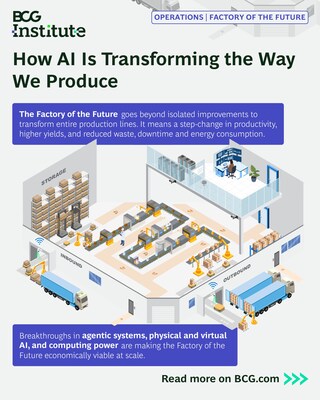
The latest report from Boston Consulting Group (BCG) and the BCG Institute, How the Factory of the Future Is Reshaping the Economics of Manufacturing, combines a global survey of 1,000 manufacturers with proprietary quantitative analysis to examine how advances in AI, automation, and digital systems are transforming production at scale.
"Manufacturers are entering a new era where competitiveness is no longer defined by static cost comparisons, but by how effectively they can redesign production setups end to end," said
Meeting the Challenges of Geopolitical Uncertainty
Powered by AI, the entire factory of the future production setup is holistically redesigned, resulting in simultaneous gains including in energy, materials, yield, and throughput. The key variables in footprint decisions are no longer relative labor costs and logistics from suppliers and to customers, but how effectively a facility can be transformed into a highly productive factory of the future. As geopolitical uncertainty deepens and supply chain volatility becomes a structural risk, this is becoming critical for manufacturers looking to increase resilience by producing where they sell.
Benefits Vary by Sector and Location
However, the factory of the future does not benefit all locations or sectors equally. Key variables include local cost factors such as energy, labor, and materials, as well as sector-dependent automation potential and share of logistics costs. Higher-cost locations see more impact from automating labor intensive tasks, optimizing energy consumption, improving yield and throughput, and narrowing the gap with low-cost locations. Sectors with a high share of logistics costs, such as food and beverages, benefit most from proximity to end markets.
Talent availability and digital infrastructure readiness are also significant factors in enabling effective adoption. In the BCG Institute survey, 87% of respondents indicated that access to talent and skills become more critical to sustain the deployment of the factory of the future, and 69% said the same for digital infrastructure.
A More Dynamic Global Manufacturing Landscape
Together, these dynamics are creating a more variable and dynamic global manufacturing landscape where competitive advantage depends on aligning sector characteristics, location capabilities, and the effective deployment of advanced production technologies. The implications for business leaders are significant. Companies must evaluate production decisions through a new lens—one that integrates technology deployment with footprint strategy and considers how production setups can be redesigned to unlock value.
"Companies that integrate footprint strategy with advanced manufacturing capabilities will be best positioned to compete in the decade ahead," Kuepper said.
Download the report here:
https://www.bcg.com/publications/2026/how-the-factory-of-the-future-reshapes-manufacturing
Media Contact:
Eric Gregoire
[email protected]
About Boston Consulting Group
Boston Consulting Group bridges the gap between ambition and outcomes for the world's leading companies and organizations. We are built for this era of unprecedented change — bringing strategic clarity rooted in over 60 years of deep domain knowledge, combined with applied AI shaped by our practitioners. BCG works shoulder-to-shoulder with CEOs across industries and geographies to deliver transformative impact at scale: stronger returns, transferred capabilities, and change that sticks. For more information, visit bcg.com.
About the BCG Institute
The BCG Institute is Boston Consulting Group's strategy think tank, dedicated to exploring and developing valuable new insights from business, technology, and science by embracing the powerful technology of ideas. The Institute engages leaders in provocative discussion and experimentation to expand the boundaries of business theory and practice and to translate innovative ideas from within and beyond business. For more ideas and inspiration from the Institute, please visit our website and follow us on LinkedIn and X (formerly Twitter).

 View original content to download multimedia:https://www.prnewswire.com/news-releases/ai-powered-factories-are-rewriting-the-rules-of-global-manufacturing-302783849.html
SOURCE Boston Consulting Group (BCG)
Serious News for Serious Traders! Try StreetInsider.com Premium Free!
You May Also Be Interested In
- With Exhibitor Space Sold Out, Registration is Open for the 2026 Building Industry Show, the "Not Your Typical Tradeshow" Experience
- NorthShore Adult Diapers Hosts First-Ever Weekend Celebration for People Living With Incontinence
- Samsung launches its first credit card in the U.S. -- A mobile wallet experience that turns everyday spending into cash rewards
Create E-mail Alert Related Categories
PRNewswire, Press ReleasesRelated Entities
TwitterSign up for StreetInsider Free!
Receive full access to all new and archived articles, unlimited portfolio tracking, e-mail alerts, custom newswires and RSS feeds - and more!
