



Amgen (AMGN) Presents New Repatha Data
 Tweet
Tweet Share
Share E-mail
_58cbc46cd3c33.jpg)
Get Alerts AMGN Hot Sheet
Overall Analyst Rating:
SELL (= Flat)
Dividend Yield: 3%
Revenue Growth %: +2.7%
Join SI Premium – FREE
Amgen (NASDAQ: AMGN) today presented a new analysis from the Phase 3 FOURIER and FOURIER open label extension (OLE) studies of Repatha® (evolocumab) in adults with atherosclerotic cardiovascular disease (ASCVD) during the Nov. 7 Late-Breaking Science Session of the American Heart Association (AHA) Scientific Sessions 2022 in Chicago, Illinois. These data demonstrated that achieving and sustaining a low-density lipoprotein cholesterol (LDL-C) level of <20 mg/dL was associated with improved cardiovascular (CV) outcomes, including the composite endpoint of cardiovascular death, myocardial infarction (MI) and stroke, with no evidence of an increased incidence of safety events for up to 8.6 years of follow-up.1
"The current analysis further supports that achieving very low LDL-C long-term is not associated with any new safety signals and correlates with the reduction in cardiovascular events in patients with atherosclerotic cardiovascular disease," said David M. Reese, M.D., executive vice president of Research and Development at Amgen. "Repatha continues to be at the forefront of PCSK9i research, with the longest safety and efficacy trial data among PCSK9i treatments for cardiovascular disease, providing crucial information for patients and doctors managing this disease."
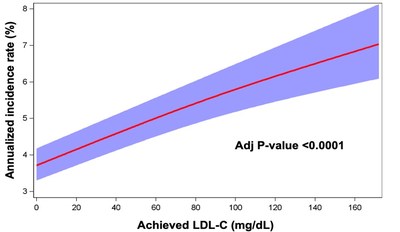
This pre-specified exploratory analysis examined the association between achievement of different LDL-C levels with the incidence of cardiovascular and safety outcomes for up to 8.6 years of follow up.1 Between the parent FOURIER and FOURIER-OLE studies, over 3,500 patients (13%) achieved LDL-C levels of <20 mg/dL and over 10,000 (39%) achieved LDL-C levels of <40 mg/dL.1 This analysis found that over the course of 77,470 patient-years of follow-up there was a monotonic relationship between lower LDL-C levels – down to very low LDL-C levels <20 mg/dL – and a lower risk of the efficacy endpoint from FOURIER of CV death, MI, stroke, coronary revascularization or hospital admission for unstable angina (see Figure 1).1
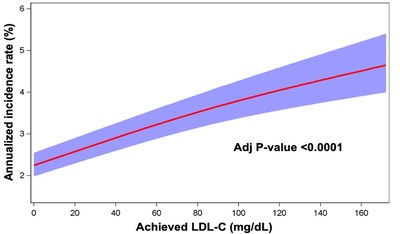
A similar relationship was observed between achieved LDL-C levels and the risk of the key secondary efficacy endpoint from FOURIER of CV death, MI or stroke (P for trend<0.0001) (see Figure 2).1 There were no significant associations between lower achieved LDL-C and the risk of serious adverse events, neurocognitive events, the development of new onset diabetes, cataract-related adverse events, new or progressive malignancy, the occurrence of hemorrhagic stroke, muscle-related events or non-cardiovascular death.1
"Until now, there was a gap in the medical knowledge of the long-term efficacy and safety implications of a very low LDL-C level <20 mg/dL," said Marc S. Sabatine, MD, Chair of the TIMI Study Group at Brigham and Women's Hospital and senior investigator for this study. "These data fill that gap by demonstrating that a lower LDL-C level was associated with improved cardiovascular outcomes with a similar safety profile, down to very low LDL-C levels. Furthermore, these data substantiate the use of a PCSK9 inhibitor to reduce LDL-C below the threshold of 55 mg/dL for very high-risk ASCVD patients, as recommended in the recently published ACC 2022 Expert Consensus Decision Pathway on the Role of Nonstatin Therapies for LDL-C Lowering in the Management of ASCVD Risk."
Prolonged LDL-C reduction with Repatha is also being studied in 12,301 patients without a prior heart attack or stroke in the ongoing VESALIUS-CV (NCT03872401) outcomes trial.
Serious News for Serious Traders! Try StreetInsider.com Premium Free!
You May Also Be Interested In
- EU approves Merck's Keytruda plus Padcev for bladder cancer
- Qualcomm to acquire AI software firm Modular Inc.
- Agility Robotics to go public via $2.5B SPAC merger
Create E-mail Alert Related Categories
Corporate News, FDARelated Entities
Barron's, Twitter, Dividend, Definitive Agreement, FDASign up for StreetInsider Free!
Receive full access to all new and archived articles, unlimited portfolio tracking, e-mail alerts, custom newswires and RSS feeds - and more!
